

Crown Reduction

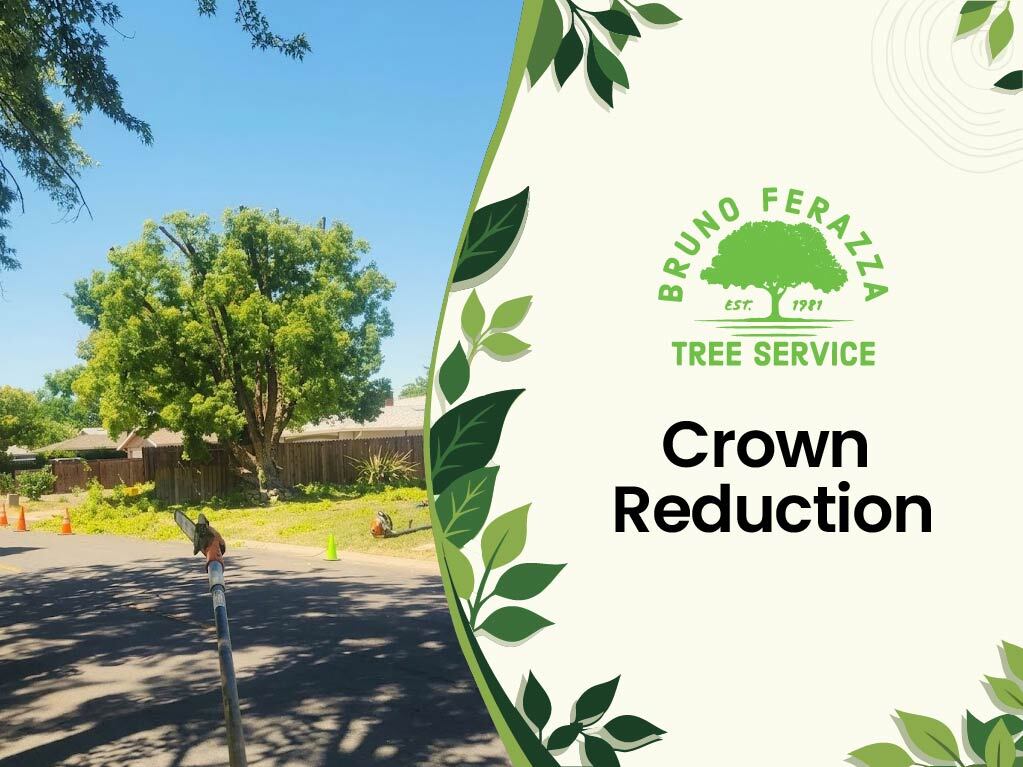
Trees do not always remain in proportion to the space around them. A canopy that once fit comfortably in a yard may eventually extend toward a roof, street, neighboring property, or other structure. When completely removing a healthy tree is not the preferred solution, carefully planned crown reduction may help manage its height or spread.
Bruno Ferazza Tree Service provides professional crown reduction throughout Greater Sacramento. We evaluate the tree and site before recommending a plan designed to achieve an appropriate size reduction while retaining a balanced outline and healthy canopy.
Call (916) 201-7462 to arrange an evaluation and request a crown reduction estimate.
What Is Crown Reduction?
Crown reduction is a pruning method used to decrease the overall height, spread, or both dimensions of a tree canopy. Selected leaders and branch ends are shortened back to suitable lateral branches. Those laterals continue the natural growth pattern, helping the tree retain a recognizable and balanced form.
This differs from cutting every branch at the same height. Effective reduction considers branch structure, species, age, condition, growth response, and the amount of live foliage that can reasonably be removed.
Crown reduction may address the entire canopy or one section. For example, the side approaching a building may need reduction while the rest requires little work.
When May a Tree Need Crown Reduction?
A property owner may consider crown reduction when:
- An overgrown canopy is approaching a roof, building, sign, or neighboring property
- Upper branches are extending into an area with limited space
- Previous limb loss has left part of the crown noticeably unbalanced
- A mature tree requires controlled size management
- Long branches need shortening while retaining appropriate lateral growth
- Clearance is needed without removing more of the canopy than necessary
- An arborist recommends reduction as part of a broader tree-management plan
Not every large tree should be reduced. Some species and stressed trees tolerate substantial pruning poorly, while the requested size change may be too severe. An inspection may instead support limited branch reduction, clearance pruning, monitoring, or removal.
Crown Reduction vs. Tree Topping
Crown reduction and tree topping are not interchangeable. Topping makes indiscriminate cuts across the canopy, often leaving large stubs or branches without suitable laterals. It can destroy the natural outline, create significant wounds, encourage weakly attached regrowth, and lead to repeated maintenance.
Proper crown reduction works with the existing branch structure. Leaders and terminals are pruned back to lateral branches capable of assuming the terminal role. The cuts are distributed selectively rather than forming a flat line across the top.
Bruno Ferazza Tree Service does not use topping as a shortcut. If a requested height requires excessive foliage removal or unsuitable cuts, we explain the concern and discuss alternatives.
Crown Reduction, Thinning, and Weight Reduction
These services solve different problems. Crown reduction decreases height or spread. Crown thinning lowers foliage density while generally retaining canopy size. Weight reduction shortens selected heavy limbs. Crown cleaning removes dead, dying, broken, or weakly attached branches, while crown raising improves clearance beneath the tree. A tree may need one treatment or a combination.
Our Crown Reduction Process
Tree and site inspection
We consider species, visible condition, branch architecture, previous pruning, nearby structures, access, and the area beneath the canopy. Visible cracks, cavities, deadwood, and weak unions can affect the scope.
Clear pruning objectives
The estimate identifies whether the goal is height reduction, spread reduction, clearance, canopy balance, or a combination. A clear scope helps prevent unnecessary cutting.
Selective reduction cuts
Branches are shortened at appropriate unions rather than cut at arbitrary points. The crew works through the canopy while considering the tree’s overall appearance and the distribution of remaining foliage. Large trees or confined sites may require climbing, rigging, aerial equipment, or crane-assisted tree work.
Controlled debris handling
Branches above obstacles may need to be lowered in sections. Cleanup, chipping, hauling, and wood handling should be identified in the estimate.
Crown Reduction Near Homes and Buildings
A large canopy close to a structure requires careful planning. The objective may be to shorten branches over a roof, establish reasonable clearance from siding, or reduce spread toward adjacent property. Cutting too aggressively can leave the crown unbalanced. Roof clearance, deadwood removal, or targeted weight reduction may complement the reduction scope.
Crown reduction can manage dimensions and leverage, but it does not make a tree risk-free or storm-proof. Roots, trunk condition, decay, attachments, weather, and site changes also matter.
Mature trees often need a conservative approach. Excessive pruning can reduce leaf area, expose previously shaded bark, and stimulate unwanted regrowth. Major corrections may be divided across pruning cycles. If you see a fresh crack, hanging limb, sudden lean, or lifted soil, keep the area clear and request an assessment. Contact the utility provider about branches near energized lines.
Crown Reduction Cost
Pricing depends on tree size, species, branch diameter, access, obstacles, equipment, rigging, and debris removal. An on-site estimate defines the work accurately. Confirm whether protected-tree rules, permits, association requirements, or utility restrictions apply.
Why Choose Bruno Ferazza Tree Service?
Crown reduction requires knowing which branches to shorten, where to place cuts, and when the requested change would be too severe. Bruno Ferazza Tree Service brings more than 40 years of tree-care experience to Greater Sacramento.
The company is led by an ISA Certified Arborist (WE-8308A) and Certified Treecare Safety Professional (CTSP 05093) and operates under CSLB #1058832. We provide clear recommendations, written scopes, professional equipment, and cleanup.
Our service area includes Roseville, Rocklin, Lincoln, Citrus Heights, Carmichael, Folsom, Auburn, Fair Oaks, Orangevale, El Dorado Hills, North Highlands, and surrounding communities.
Request a Crown Reduction Estimate
If a tree has outgrown its space, let Bruno Ferazza Tree Service explain whether selective crown reduction is appropriate.
Call (916) 201-7462 to request an on-site evaluation and estimate.
Any Questions? Ask Us!!
Our Working Process
STEP 01
Inspection & Consultation
STEP 02
Planning & Preparation
STEP 03
Execution & Care
STEP 04
Cleanup & Final Review
Frequently Asked Questions
We answered your frequently asked questions here:
What is tree roof clearance?
It is selective pruning that creates separation between tree branches and a roof or related building features. The work may involve reducing or removing specific limbs based on tree structure.
How much clearance should branches have from a roof?
There is no single distance suitable for every tree and property. Species, branch movement, roof features, utility lines, local requirements, and the pruning points available all influence the practical clearance.
Will roof clearance stop leaves from entering my gutters?
It may reduce the amount of nearby debris, but it cannot prevent all leaves, seeds, and twigs from reaching a roof or gutter. Wind can carry material from trees elsewhere on the property or neighborhood.
Can you prune branches over solar panels?
Often, yes. The tree, panel location, roof material, access, and rigging options must be evaluated. The work may improve access or reduce shading, but solar-performance questions should be directed to the solar provider.
Does roof clearance prevent storm damage?
No pruning service can guarantee that storm damage will not occur. Appropriate clearance and removal of identified defective branches may help manage specific concerns, but extreme weather and hidden defects remain unpredictable.
Should every branch over a roof be removed?
No. Some limbs can be shortened to suitable laterals, and healthy branches may not require removal. The pruning plan should balance clearance with tree structure and canopy health.
Is roof clearance the same as tree topping?
No. Topping makes indiscriminate cuts and leaves stubs or unsuitable lateral growth. Professional clearance pruning uses selected cuts based on branch structure and a defined objective.
How often should roof clearance be repeated?
Frequency depends on species, growth rate, distance from the building, and previous pruning. Regular inspection can identify developing conflicts before they require larger cuts.
Is cleanup included?
The written estimate should identify chipping, hauling, larger wood, and cleanup arrangements. Bruno Ferazza Tree Service explains the debris plan before scheduling.
How do I request an estimate?
Call Bruno Ferazza Tree Service at (916) 201-7462. Mention the tree’s location, roof material, nearby utility lines, solar panels, access limitations, and any branches that appear damaged.