

Tree Crane Work

Tree Crane Work
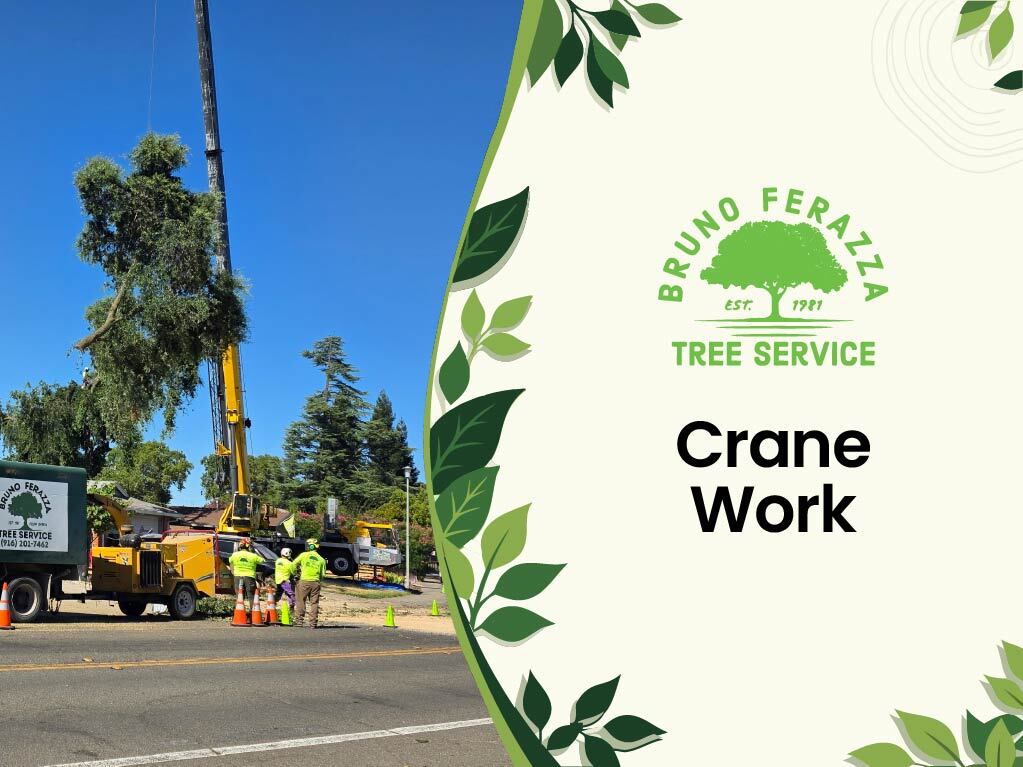
Some trees cannot be removed with a simple ground approach. A canopy may extend above a roof, a declining trunk may not suit conventional rigging, or a yard may have no drop zone. A crane may lift selected sections to a processing area.
Bruno Ferazza Tree Service provides crane assisted tree work throughout the greater Sacramento region. With more than 40 years of experience, we evaluate the tree, structures, crane access, lifting radius and landing zone before recommending equipment.
Crane work is not automatically best. Many removals use climbing, rigging, lift equipment or ground operations. The method depends on the site.
When Is a Crane Used for Tree Removal?
A crane may be considered for large or difficult sections, including:
- A tree with major limbs above a home, garage or commercial building
- A large tree surrounded by fences, pools, patios or landscaping
- A dead or declining tree that may not support ordinary climbing or rigging loads
- A storm-damaged tree with split, hanging or unstable sections
- A tall tree with very limited room for lowering wood
- A backyard tree that must be lifted over a structure
- Heavy trunk sections that are difficult to move across the ground
- A commercial site where a defined lifting and landing plan reduces disruption
These conditions do not prove a crane is required. An assessment compares feasibility, setup space, reach and conventional methods.
How Crane-Assisted Tree Removal Works
Crane removal is performed in planned sections. The crane is positioned on suitable ground, outriggers are deployed and the work zone is restricted. The crew and operator coordinate each lift.
A branch or trunk section is rigged and supported before it is cut and lifted to the landing zone. Ground personnel then process it into logs, branches or chip material.
Each lift accounts for estimated weight, crane capacity, boom angle, radius, wind, tree condition and obstacles. Operations must remain within equipment limits.
Site Access and Crane Setup
Feasibility depends on parking, entry and exit, ground condition, overhead obstructions and room for outriggers.
Important site details may include:
- Driveway width, slope and weight limits
- Underground utilities and septic components
- Overhead lines and road conditions
- Nearby structures and neighboring property
- Boom reach and landing-zone space
- Space for chipping and debris loading
Soft ground, underground structures or limited setup space may require another position, smaller pieces or a different method.
Crane Work Near Homes and Other Structures
For trees above roofs or outdoor areas, a crane may lift selected pieces away from the structure instead of lowering them through a confined ground area.
Crane use does not eliminate risk or justify oversized cuts. Planning, controlled cutting, communication and landing-zone management remain essential. Vehicles and occupants must stay outside the work area.
Hazardous, Dead and Storm-Damaged Trees
Dead or damaged trees may contain brittle wood, hidden decay or tensioned sections. They require evaluation before climbing, cutting or rigging.
A crane may support pieces before separation, but another approach may suit the tree better. Potential failure paths must be considered first.
If a tree or branch contacts an energized line, stay away and contact the responsible utility or emergency authority. Crane-assisted tree work is not a substitute for utility response, and ordinary operations should not begin until electrical hazards have been resolved.
Residential and Commercial Crane Tree Work
Residential projects may involve tight yards, trees above roofs, pools and neighboring property. Residents may need to move vehicles and belongings and remain outside the work zone.
Commercial work may serve apartments, offices, retail sites, associations or industrial properties. Planning accounts for customers, parking, deliveries, access and possible traffic control.
Permits, Traffic Control and Neighbor Access
A project may require tree-removal approval based on jurisdiction and tree status. Crane placement in a street or right-of-way may require separate authorization.
Neighboring-property access requires owner permission, and utility coordination may be necessary. Confirm requirements with responsible agencies and state permit responsibilities in writing.
Cleanup, Logs and Stump Grinding
Crane removal produces branches, logs, chips and a stump. The estimate should state what is chipped, hauled, cut into rounds or left. Large logs need separate handling.
Stump grinding is separate. Request it with the crane-removal estimate if desired.
What Affects Crane Tree Work Cost?
Pricing factors include:
- Tree size, species and structural condition
- Planned lift weights and locations
- Crane type, radius and setup time
- Landing-zone distance
- Ground and outrigger requirements
- Crew, rigging and processing equipment
- Traffic control, permits and cleanup
A crane may reduce project duration but adds equipment, operator and setup costs. It is not automatically faster, safer or cheaper. A site-specific estimate allows comparison.
Why Choose Bruno Ferazza Tree Service?
Bruno Ferazza Tree Service brings decades of practical tree-care experience to difficult removals and crane-assisted projects. Our published credentials include Certified Arborist WE-8308A, Certified Treecare Safety Professional CTSP 05093 and California contractor license CSLB #1058832.
We serve Roseville, Rocklin, Lincoln, Citrus Heights, Carmichael, Folsom, Auburn, Fair Oaks, Orangevale, El Dorado Hills and North Highlands. Contact us to confirm availability and suitability.
Concerned about a large, hazardous or difficult-access tree? Call Bruno Ferazza Tree Service at (916) 201-7462 to request a crane-work assessment and estimate.
Our Working Process
STEP 01
Inspection & Consultation
STEP 02
Planning & Preparation
STEP 03
Execution & Care
STEP 04
Cleanup & Final Review
Frequently Asked Questions
We answered your frequently asked questions here:
When does tree removal require a crane?
A crane may suit trees with limited drop space, heavy sections or compromised structure. An assessment determines feasibility.
Is crane tree removal safer than regular removal?
It can provide control in suitable situations but is not automatically safer. Capacity, setup, tree condition, rigging and communication matter.
Can a crane reach a tree in my backyard?
Possibly. Setup location, radius, obstacles and piece weights determine reach. A site visit is required.
Does the crane need to enter my yard?
Not always. A crane may set up on a driveway, private paved area or authorized street location and reach the tree from there. Ground strength, access and permits determine suitable placement.
Can you remove a tree over a house or pool?
Crane assistance may be appropriate for trees above houses, pools or other structures. The tree, lift path, setup area and landing zone must be evaluated before the method is confirmed.
Do I need a permit for crane-assisted tree removal?
You may need a tree-removal permit and separate approval for crane placement or traffic control. Requirements vary by jurisdiction and site. Confirm them with the responsible agencies.
Is cleanup included with crane work?
Cleanup should be defined in the estimate. Confirm how branches, logs, chips and smaller debris will be handled and whether material will be hauled or left on site.
Is stump grinding included?
Not automatically. Stump grinding is a separate service and should be listed in the written scope if requested.
How can I request a crane-work estimate?
Call (916) 201-7462 with the property address, tree concern and access details. A site assessment can then evaluate crane setup, reach, landing zone, cleanup and permit considerations.