
Mistletoe Removal

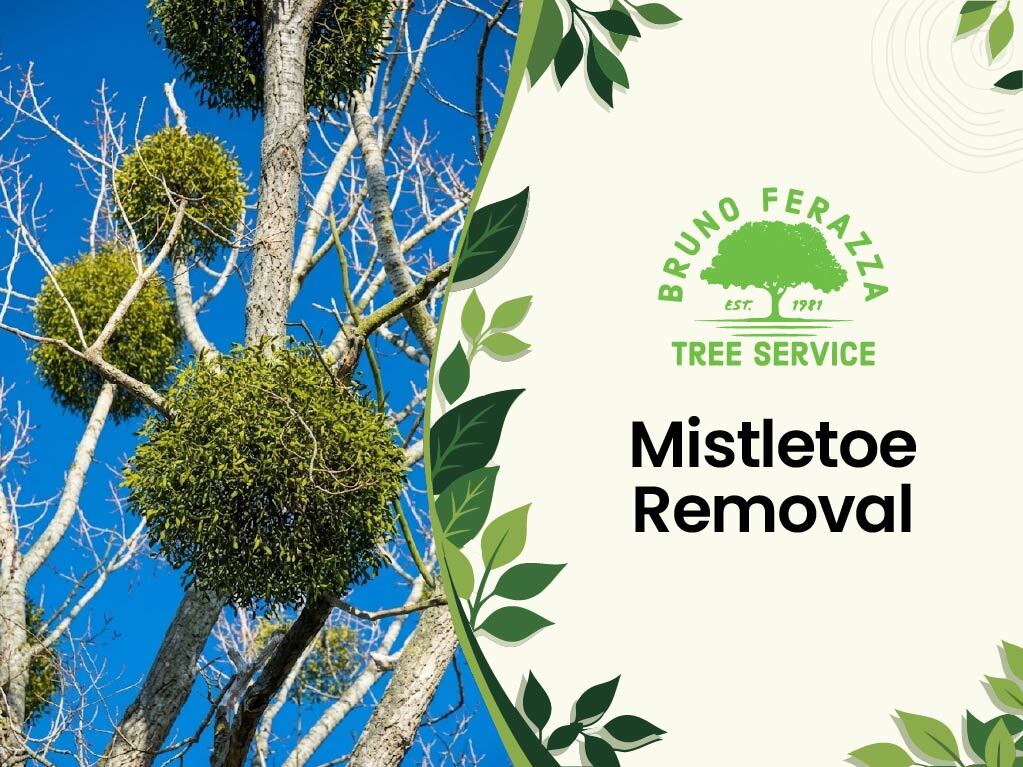
Mistletoe can look like a harmless green cluster in a bare winter canopy, but it is a parasitic plant that draws water and nutrients from its host. One small clump may be easy to overlook. Over time, additional growth can appear on other branches or nearby susceptible trees, particularly when birds spread the sticky seeds.
Bruno Ferazza Tree Service provides professional mistletoe removal and pruning for residential and commercial properties throughout Greater Sacramento. We inspect the canopy, identify visible infestations, and recommend a practical management plan based on the tree’s species, condition, structure, and level of infection.
Early attention usually provides more pruning options than waiting until numerous major limbs are affected. Call (916) 201-7462 to request an on-site evaluation and mistletoe removal estimate.
What Is Mistletoe?
Mistletoe is a flowering parasitic plant that grows on the branches or trunks of host trees. Its root-like structures, known as haustoria, penetrate beneath the bark and connect with the tree’s conducting tissues. The visible leafy cluster is only part of the plant; the internal system can extend into the branch.
Because mistletoe remains green while many deciduous trees are leafless, infestations are often easiest to notice during winter. Common signs include rounded green clumps in the canopy, swollen branch areas near an attachment point, declining twigs beyond a cluster, or repeated growth from a location that was previously cut back.
Mistletoe does not automatically mean a tree must be removed. The appropriate response depends on how many branches are affected, where the infestations are located, how vigorous the tree is, and whether sound pruning can remove infected wood without sacrificing too much of the canopy.
Why Mistletoe Management Matters
A mistletoe plant takes water and mineral nutrients from its host. A healthy, well-established tree may tolerate a limited infestation for some time, but multiple clusters can add stress—especially when the tree is also affected by drought, poor irrigation, root damage, decay, pests, or other environmental pressures.
Branches supporting heavy growth may decline or die back. Mature mistletoe can also produce berries containing seeds that birds carry to other parts of the same tree or to nearby trees. Removing visible infestations before seed production may help limit further spread, although it cannot guarantee that no new plants will appear.
Professional management focuses on the whole tree rather than simply pulling off the green foliage. The objective is to reduce the current infestation, preserve reasonable structure, and establish realistic expectations for monitoring.
How Is Mistletoe Removed?
Pruning an infested branch is generally the most effective mechanical control when the branch can be removed appropriately. The cut may need to be made well below the visible attachment because internal mistletoe tissue can extend into the wood. Depending on branch architecture, an infected limb may be removed at its point of origin or reduced to an appropriate lateral branch.
Simply breaking off the visible cluster does not usually remove the embedded portion. It can temporarily improve appearance and may reduce seed production, but shoots are likely to return. When mistletoe grows on the trunk or a major structural limb that cannot reasonably be removed, complete control becomes more difficult. Periodic removal of visible shoots may be considered as a suppression measure.
Every tree is different. Removing all infected branches from a heavily infested tree could leave an unacceptable canopy or require large structural cuts. In those cases, the recommendations may involve staged pruning, ongoing suppression, monitoring, or tree removal when condition and risk justify it.
Our Mistletoe Removal Process
Canopy and site inspection
We locate visible clusters and consider branch size, attachment points, canopy distribution, access, and obstacles below the tree. We also check for deadwood, cracks, cavities, declining limbs, and previous pruning that may influence the plan.
A tree-specific recommendation
The proposed scope identifies which infested branches can be removed, which visible shoots may only be suppressed, and whether other pruning is advisable. We explain when complete removal is not realistic and when follow-up inspection may be needed.
Selective pruning
Our crew makes planned pruning cuts while retaining as much suitable live canopy as practical. Work on tall trees or above roofs, driveways, fences, and landscaping may require climbing, rigging, aerial equipment, or crane assistance.
Debris handling
Cut branches and mistletoe material are controlled and removed according to the written estimate. Chipping, hauling, larger wood, and final cleanup should be discussed before the project is scheduled.
Mistletoe Removal Is Not Tree Topping
Removing the entire top of a tree is not an appropriate shortcut for mistletoe control. Topping leaves large wounds, damages natural form, and can encourage weakly attached regrowth. It may also fail to address infestations located elsewhere in the canopy.
Effective pruning follows branch structure and balances mistletoe management with the tree’s ability to retain adequate live foliage. If proper removal would require excessive canopy loss, Bruno Ferazza Tree Service will explain the limitation instead of promising a result that could harm the tree.
Can Mistletoe Grow Back?
Yes. Regrowth is possible when the internal portion remains inside a branch. New infections may also develop when birds spread seed from untreated mistletoe nearby. For that reason, mistletoe service is often best viewed as management rather than a one-time guarantee of permanent eradication.
Property owners should inspect susceptible trees regularly. Young clusters are easier to address before they spread extensively or become established on large scaffold limbs. Follow-up pruning may be recommended as part of ongoing tree maintenance.
When Is Tree Removal Considered?
Mistletoe alone does not always justify removing a tree. However, removal may be discussed when an infestation is severe, most manageable branches are affected, the tree is already declining, structural defects are present, or pruning would leave too little viable canopy. A heavily infested tree may also continue serving as a seed source for nearby susceptible trees.
The decision should consider the tree’s condition, landscape value, targets around it, and the feasibility of continued management. Our role is to explain the options so the property owner can make an informed choice.
Mistletoe Removal Cost
Cost varies according to tree height, number and location of clusters, branch diameter, canopy density, site access, nearby structures, equipment requirements, rigging, and debris handling. Removing one accessible infested branch differs from pruning multiple clusters high above a roof.
An on-site visit allows us to identify visible infestations and prepare a defined scope. Protected-tree rules, permits, homeowners association requirements, and utility restrictions may also apply depending on the property and jurisdiction.
Why Choose Bruno Ferazza Tree Service?
Mistletoe management requires accurate pruning and honest expectations. Bruno Ferazza Tree Service brings more than 40 years of tree-care experience to properties across Greater Sacramento. The company is led by an ISA Certified Arborist (WE-8308A) and Certified Treecare Safety Professional (CTSP 05093) and operates under California contractor license CSLB #1058832.
We serve Roseville, Rocklin, Lincoln, Citrus Heights, Carmichael, Folsom, Auburn, Fair Oaks, Orangevale, El Dorado Hills, North Highlands, and surrounding communities. Whether you have one visible cluster or mistletoe across several trees, we can evaluate the site and recommend appropriate next steps.
Call (916) 201-7462 to request a mistletoe removal estimate.
Any Questions? Ask Us!!
Our Working Process
STEP 01
Inspection & Consultation
STEP 02
Planning & Preparation
STEP 03
Execution & Care
STEP 04
Cleanup & Final Review
Frequently Asked Questions
We answered your frequently asked questions here:
Does mistletoe harm trees?
Mistletoe takes water and mineral nutrients from its host. A light infestation may be tolerated, but multiple plants can add stress and contribute to branch decline, especially when a tree faces drought, root damage, or other health problems.
Can mistletoe be removed permanently?
Complete control is possible when an infected branch can be properly removed far enough below the attachment. If internal tissue remains in a major limb or trunk, visible shoots may return. New seeds can also create future infections.
Can I pull mistletoe out of a tree?
Pulling off the green cluster removes only the visible growth and usually leaves embedded tissue behind. It may temporarily reduce seed production, but professional pruning offers better control where suitable branch removal is possible.
How far below mistletoe should a branch be cut?
The correct cut depends on the infestation and branch structure. Guidance commonly recommends removing infected branches at their origin or back to a large lateral, with the cut potentially made at least one foot below the visible attachment.
Will mistletoe removal save my tree?
Removal can reduce the parasitic load, but results depend on the tree’s condition and the infestation’s extent. Pruning cannot reverse serious decay, root problems, or structural defects.
When is mistletoe easiest to see?
It is often most noticeable on deciduous trees after leaves have fallen because the evergreen clusters stand out in the canopy. Work timing should still account for the host species and tree condition.
Do heavily infested trees need removal?
Not automatically. Removal may be considered when infestation is widespread, the tree is declining or structurally compromised, or pruning would remove too much live canopy. An inspection is needed before deciding.
Can mistletoe spread to nearby trees?
Yes. Birds commonly move the sticky seeds between branches and trees. Removing plants before they produce seed and monitoring surrounding susceptible trees may help reduce further spread.
Is cleanup included with the service?
The written estimate should specify branch removal, chipping, hauling, larger wood, and cleanup. We explain the debris plan before scheduling the work.
How do I request an estimate?
Call Bruno Ferazza Tree Service at (916) 201-7462. Tell us how many trees appear affected, whether clusters are high in the canopy, and whether branches are above structures or utility lines.