


Tree Weight Reduction


Tree Weight Reduction

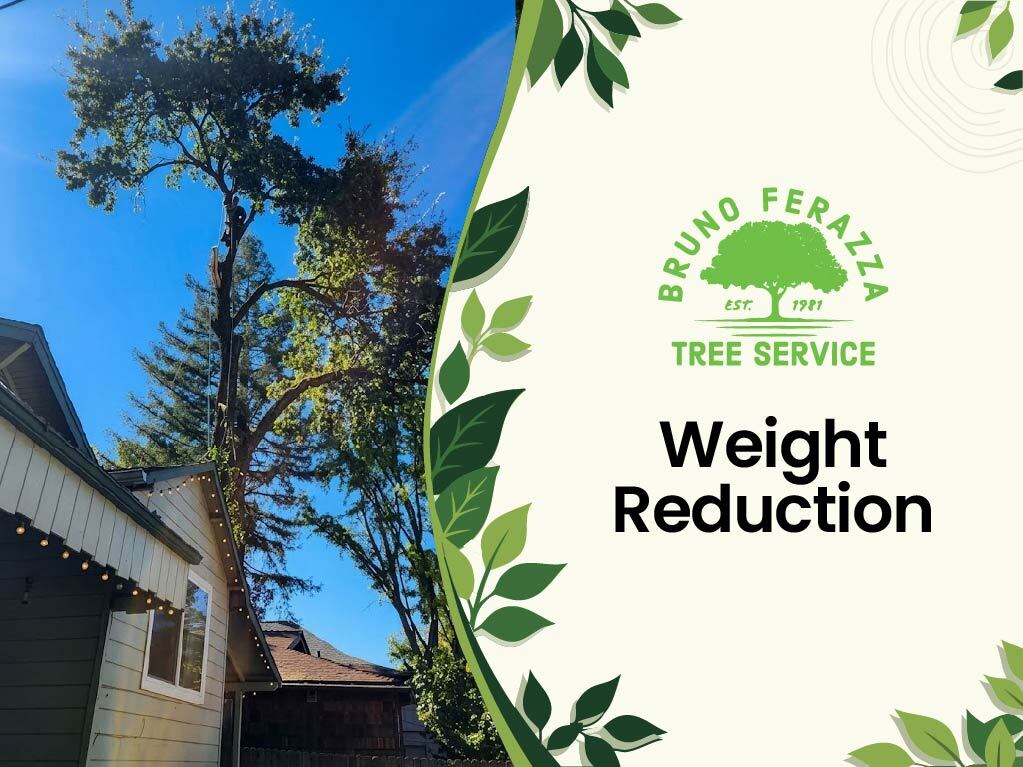
A mature tree brings shade, privacy, and character to a property. As it grows, however, one limb may extend farther than the rest of the canopy or become heavily weighted at the end. A branch reaching over a roof, driveway, patio, street, or neighboring property may need more than routine trimming. It may benefit from carefully planned tree weight reduction.
Bruno Ferazza Tree Service provides professional tree weight reduction throughout the Greater Sacramento area. We evaluate the tree, identify a clear pruning objective, and selectively shorten appropriate branches while preserving as much healthy canopy and natural form as practical. If a long or heavy limb concerns you, call (916) 201-7462 to request an on-site evaluation and estimate.
What Is Tree Weight Reduction?
Tree weight reduction is a selective pruning method used to reduce the length and leverage of a limb. Small portions near the end of an overextended branch are removed at suitable lateral branches. Shortening the limb can move its center of gravity closer to the trunk or supporting union, reducing the mechanical load created by its length.
The service may also be called end-weight reduction, limb reduction, or branch reduction pruning. It is a precise treatment, not an instruction to remove as much foliage as possible. The location and amount of pruning depend on the species, tree condition, branch structure, surrounding targets, and purpose of the work.
When Should Weight Reduction Be Considered?
An arborist may recommend branch weight reduction when a limb has grown beyond the surrounding canopy, extends toward a structure, or places substantial leverage on a concerning union. Common situations include:
- Long limbs over a home, garage, driveway, pool, or outdoor living area
- Branches carrying most of their foliage near the ends
- An unbalanced canopy following storm damage or previous pruning
- Limbs growing toward buildings, fences, signs, or neighboring property
- Mature trees that may benefit from shortening a limb instead of removing it entirely
- Selected branches with structural concerns that require professional evaluation
Not every large limb needs reduction, and pruning does not eliminate all risk. Trees are living structures affected by weather, decay, roots, soil changes, and previous damage. An inspection helps determine whether reduction pruning is appropriate or another option should be considered.
Weight Reduction vs. Crown Reduction
These terms are related but do not always describe the same scope. Tree weight reduction often targets one or several long, heavy branches. Crown reduction generally reduces the height or spread of a larger portion of the canopy. Both should use selective cuts back to suitable lateral branches rather than leaving random stubs.
For example, a shade tree may have one extended limb over a roof while the rest of the crown fits the site. The recommendation might be end-weight reduction on that limb alone. A tree that has outgrown its available space may require a broader crown-reduction plan. The correct service begins with the tree and the objective, not a predetermined percentage of canopy removal.
Weight Reduction Is Not Tree Topping
Tree topping indiscriminately cuts branches to stubs or to laterals too small to assume the terminal role. It can damage natural form, create large wounds, and encourage poorly attached regrowth. Proper reduction pruning uses selected branch unions and considers how the remaining branch will respond.
When a requested reduction would require excessive canopy loss or inappropriate cuts, we explain the concern and discuss practical alternatives, including lighter pruning, monitoring, support evaluation, or removal.
Our Tree Weight Reduction Process
Tree and site evaluation
We review the species, visible condition, branch architecture, access, previous pruning, and nearby structures. We also identify targets beneath or beside the limb, such as a residence, walkway, vehicle area, or utility line.
A defined pruning objective
Each cut should have a purpose. The goal may be to shorten an overextended branch, gain reasonable clearance, improve balance, or reduce leverage on a particular union. Defining it helps prevent unnecessary foliage removal.
Selective pruning and controlled handling
Suitable branches are shortened back to appropriate laterals. Cut placement and the amount of live foliage removed are considered in relation to tree condition. Branches above roofs, fences, or landscaping may be lowered in sections. Large trees and restricted sites can require specialized climbing, rigging, or crane-assisted methods.
Heavy Limbs Near Homes and Driveways
Branches over occupied areas deserve attention, but proximity alone does not prove that a limb is unsafe. We look for cracks, cavities, deadwood, weak attachments, poor taper, unusual movement, past failures, or an uneven canopy. We also consider what could be affected if a branch failed.
Where appropriate, selective reduction may decrease leverage while retaining much of the limb and its shade. If an inspection reveals serious decay, a split union, or another condition that pruning alone cannot address, we will discuss other options. No pruning treatment can guarantee that a branch will never fail, especially during extreme weather.
Large trees may respond poorly to aggressive canopy removal. A conservative plan can spread corrective pruning over more than one cycle. If you notice a fresh crack, hanging branch, sudden lean, lifted soil, or storm damage, keep people and vehicles away and request an evaluation. Never approach branches near energized lines; contact the electric utility.
Cost of Tree Weight Reduction
Cost depends on tree height, limb diameter, position, access, equipment, rigging, and debris handling. An accessible branch and a limb above a tiled roof require different work plans.
An on-site estimate defines the objective and scope. Protected-tree and permit requirements vary by jurisdiction, species, and property.
Why Choose Bruno Ferazza Tree Service?
Tree weight reduction requires judgment. Removing too little may not meet the objective, while removing too much can stress the tree and spoil its form. Bruno Ferazza Tree Service brings more than 40 years of tree-care experience to Greater Sacramento. The company is led by an ISA Certified Arborist (WE-8308A) and Certified Treecare Safety Professional (CTSP 05093) and operates under California contractor license CSLB #1058832.
We serve Roseville, Rocklin, Lincoln, Citrus Heights, Carmichael, Folsom, Auburn, Fair Oaks, Orangevale, El Dorado Hills, North Highlands, and surrounding communities.
Call (916) 201-7462 to schedule an evaluation and request an estimate for professional tree weight reduction.
Our Working Process
STEP 01
Inspection & Consultation
STEP 02
Planning & Preparation
STEP 03
Execution & Care
STEP 04
Cleanup & Final Review
Frequently Asked Questions
We answered your frequently asked questions here:
What is tree weight reduction?
It is selective pruning that shortens long or heavy limbs, generally by cutting branch ends back to suitable laterals. The goal is to reduce length and leverage while retaining natural form where practical.
Is weight reduction the same as crown reduction?
Not always. Weight reduction may focus on a few overextended limbs. Crown reduction usually decreases the height or spread of a broader portion of the canopy.
Will weight reduction stop a branch from breaking?
No service can guarantee that a branch will never fail. Proper reduction may reduce mechanical load, but risk also depends on defects, decay, roots, weather, and site conditions.
Can you reduce a limb hanging over my roof?
Often, yes. We evaluate the limb, attachment, available pruning points, required clearance, and obstacles below. Rigging or crane assistance may be used when appropriate.
Is tree topping a form of weight reduction?
No. Topping makes indiscriminate cuts and leaves stubs or undersized laterals. Proper reduction uses selected cuts at suitable branch unions.
How much of a limb should be removed?
There is no universal percentage. The appropriate amount depends on species, vitality, age, branch structure, defects, and the pruning objective.
When is the best time for this service?
Timing varies by species, tree condition, pruning goal, and pest or disease concerns. Broken or hanging branches may need prompt attention; planned work should follow an arborist’s evaluation.
Do I need a pruning permit?
Possibly. Rules differ among cities, counties, associations, and protected-tree programs. Confirm requirements for the property and tree before work begins.
How do I request an estimate?
Call Bruno Ferazza Tree Service at (916) 201-7462. Mention the tree’s location and whether the limb is near a building, roadway, utility line, or other obstacle.