
Roof Clearance

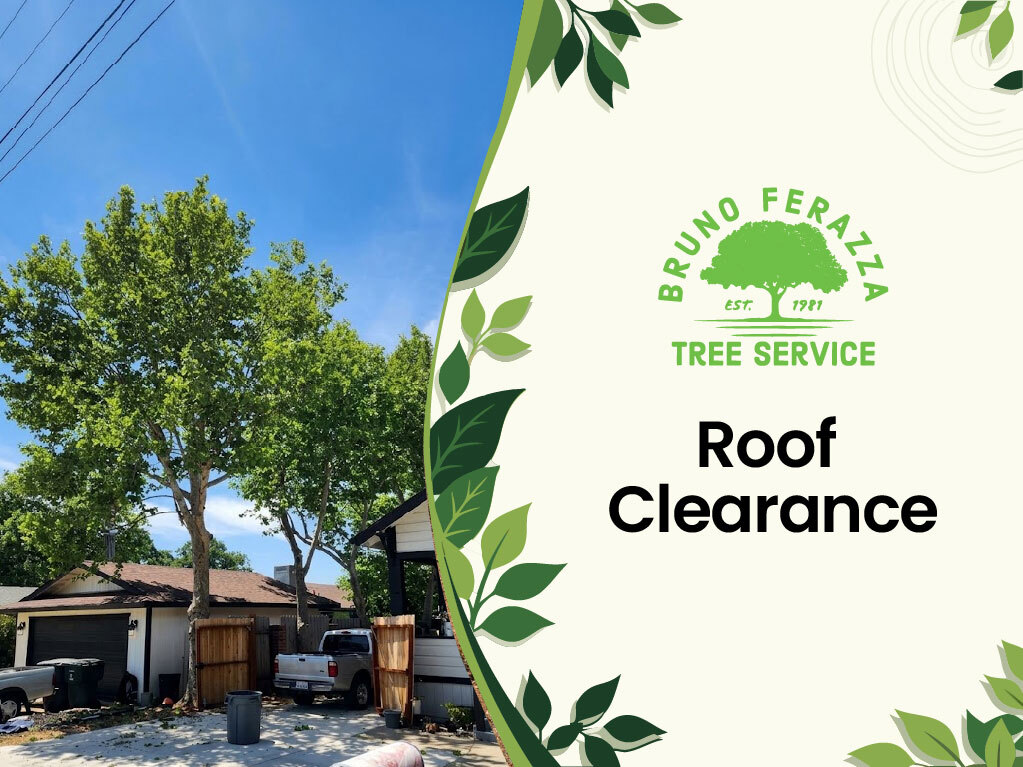
Branches growing over or against a building can create an ongoing maintenance concern. Twigs may scrape roofing materials, leaves can collect in roof valleys and gutters, and long limbs may become harder to manage as they increase in size. The right response is not always to remove the entire branch or tree. Carefully planned roof clearance pruning can establish practical separation while retaining a healthy, balanced canopy.
Bruno Ferazza Tree Service provides tree roof clearance for homes, commercial buildings, rental properties, homeowners associations, and managed landscapes throughout Greater Sacramento. We inspect the tree, roofline, access, and surrounding obstacles before defining the work. Our goal is to address the clearance concern while preserving appropriate branch structure and as much useful canopy as practical.
Call (916) 201-7462 to request an on-site roof clearance evaluation and estimate.
What Is Tree Roof Clearance?
Tree roof clearance selectively prunes branches growing above, beside, or against a roof. The scope may include limbs near roofing, gutters, eaves, skylights, chimneys, solar panels, siding, or rooftop equipment.
Clearance pruning is not the same as cutting every limb back to the trunk. Some branches may be reduced to suitable lateral growth, while others may require removal at their point of origin. The best approach depends on the tree’s species, structure, condition, distance from the building, and the amount of separation that can be created without leaving an unbalanced canopy.
Clearance should be realistic. Trees continue growing, and wind moves flexible branches beyond their resting position. The estimate should identify the areas addressed and expected result.
When Should You Consider Roofline Tree Trimming?
An inspection may be useful when:
- Branches touch or scrape the roof, gutters, siding, or eaves
- Limbs extend across roof valleys, skylights, chimneys, or solar panels
- Dead, cracked, or storm-damaged branches are suspended above a building
- Leaf and twig accumulation is repeatedly associated with an overhanging canopy
- Branches restrict access needed for roof, gutter, chimney, or solar maintenance
- A long limb has become heavily extended toward the house
- A tree has outgrown the space between its trunk and the building
- Previous pruning has produced fast, poorly placed regrowth near the roofline
Branches above a roof are not automatically hazardous, and pruning cannot guarantee against damage. Tree condition, attachments, roots, exposure, and surrounding targets all matter.
Roof Clearance vs. General Tree Trimming
General tree trimming can include deadwood removal, structural pruning, crown cleaning, size management, and other objectives. Roof clearance is more specific: it creates separation between selected branches and a building.
Several pruning methods may support that objective. Branch reduction shortens a limb to an appropriate lateral. Crown raising addresses lower branches when additional space is needed beneath the canopy. Weight reduction may shorten a long limb extending toward the roof. Crown reduction may be considered when a larger portion of the canopy has outgrown the available space.
Our Roof Clearance Process
Tree and building evaluation
We review the roofline, tree species, visible condition, branch structure, prior pruning, access, and obstacles beneath the work. We also look for deadwood, cracks, weak unions, decay indicators, and storm damage that may affect the scope.
A defined clearance objective
The proposed work identifies the roof areas and branches to be addressed. We explain whether limbs will be shortened, removed, or managed through a combination of techniques. If the requested clearance would require excessive canopy removal or poor cuts, we discuss alternatives.
Controlled pruning near the structure
Branches are pruned at appropriate unions rather than cut at arbitrary points. When limbs cannot safely fall freely, ropes and rigging may be used to lower sections in a controlled manner. Large trees or confined properties can require aerial equipment or crane-assisted tree work.
Protecting the Tree While Creating Clearance
Aggressive cutting may create a temporary gap, but it can also leave large wounds, unbalance the crown, or stimulate vigorous regrowth. Topping branches along an imaginary line above the roof is not professional clearance pruning. A better plan works with natural branch unions and considers how the remaining canopy will develop.
Mature trees often benefit from a conservative approach. When a tree has grown too close to a building for many years, reaching the desired clearance in one visit may require more live foliage removal than is advisable. Phased pruning across multiple cycles may be a better option.
In some cases, suitable pruning points do not exist, the tree is structurally compromised, or the trunk is located too close to the building for ongoing clearance to be practical. Tree removal may then be discussed, but it should follow an evaluation rather than being treated as the automatic answer.
Branches Above Gutters, Solar Panels, and Skylights
Different roof features create different constraints. Gutters, skylights, solar panels, chimneys, fragile materials, and limited access affect how branches must be controlled.
Roof clearance may reduce direct contact and make routine property maintenance easier, but it is not a substitute for roof repair, gutter cleaning, pest exclusion, or fire-code compliance. Bruno Ferazza Tree Service performs tree work; a qualified roofing, solar, pest-control, or fire-safety professional should address concerns within those trades.
Utility Lines Near the Roof
Electrical service lines sometimes run through the same area as overhanging branches. Do not touch or attempt to prune a branch that contacts or is close to an energized line. Contact the electric utility for guidance. Utility clearance requirements and responsibility can differ from ordinary roofline pruning.
Point out all overhead lines and service connections during the estimate.
How Often Is Roof Clearance Needed?
There is no universal schedule. Growth rate, species, previous cuts, desired separation, wind exposure, and distance from the building affect how quickly branches return. Fast-growing trees may need more frequent attention than slow-growing mature specimens.
Regular inspection is more useful than waiting for branches to press against the building. Early pruning may allow smaller cuts and more options for directing growth. Timing can also vary by species, tree condition, seasonal growth, and local pest or disease concerns.
Roof Clearance Cost
Cost depends on tree height, branch diameter, roof material, access, equipment, rigging, and debris handling. An accessible limb differs from large branches above tile, solar panels, or a multi-story structure.
An on-site estimate provides a clear scope based on the actual tree and building. Property owners should also confirm protected-tree permits, homeowners association rules, neighbor permissions, and other local requirements when applicable.
Why Choose Bruno Ferazza Tree Service?
Roof clearance requires accurate pruning and careful material handling around valuable structures. Bruno Ferazza Tree Service brings more than 40 years of tree-care experience to residential and commercial properties throughout Greater Sacramento.
The company is led by an ISA Certified Arborist (WE-8308A) and Certified Treecare Safety Professional (CTSP 05093) and operates under California contractor license CSLB #1058832. We provide clear recommendations, written scopes, professional equipment, and job-site cleanup.
Our service area includes Roseville, Rocklin, Lincoln, Citrus Heights, Carmichael, Folsom, Auburn, Fair Oaks, Orangevale, El Dorado Hills, North Highlands, and surrounding communities.
Call (916) 201-7462 to request a professional tree roof clearance estimate.
Any Questions? Ask Us!!
Our Working Process
STEP 01
Inspection & Consultation
STEP 02
Planning & Preparation
STEP 03
Execution & Care
STEP 04
Cleanup & Final Review
Frequently Asked Questions
We answered your frequently asked questions here:
What is tree roof clearance?
It is selective pruning that creates separation between tree branches and a roof or related building features. The work may involve reducing or removing specific limbs based on tree structure.
How much clearance should branches have from a roof?
There is no single distance suitable for every tree and property. Species, branch movement, roof features, utility lines, local requirements, and the pruning points available all influence the practical clearance.
Will roof clearance stop leaves from entering my gutters?
It may reduce the amount of nearby debris, but it cannot prevent all leaves, seeds, and twigs from reaching a roof or gutter. Wind can carry material from trees elsewhere on the property or neighborhood.
Can you prune branches over solar panels?
Often, yes. The tree, panel location, roof material, access, and rigging options must be evaluated. The work may improve access or reduce shading, but solar-performance questions should be directed to the solar provider.
Does roof clearance prevent storm damage?
No pruning service can guarantee that storm damage will not occur. Appropriate clearance and removal of identified defective branches may help manage specific concerns, but extreme weather and hidden defects remain unpredictable.
Should every branch over a roof be removed?
No. Some limbs can be shortened to suitable laterals, and healthy branches may not require removal. The pruning plan should balance clearance with tree structure and canopy health.
Is roof clearance the same as tree topping?
No. Topping makes indiscriminate cuts and leaves stubs or unsuitable lateral growth. Professional clearance pruning uses selected cuts based on branch structure and a defined objective.
How often should roof clearance be repeated?
Frequency depends on species, growth rate, distance from the building, and previous pruning. Regular inspection can identify developing conflicts before they require larger cuts.
Is cleanup included?
The written estimate should identify chipping, hauling, larger wood, and cleanup arrangements. Bruno Ferazza Tree Service explains the debris plan before scheduling.
How do I request an estimate?
Call Bruno Ferazza Tree Service at (916) 201-7462. Mention the tree’s location, roof material, nearby utility lines, solar panels, access limitations, and any branches that appear damaged.